
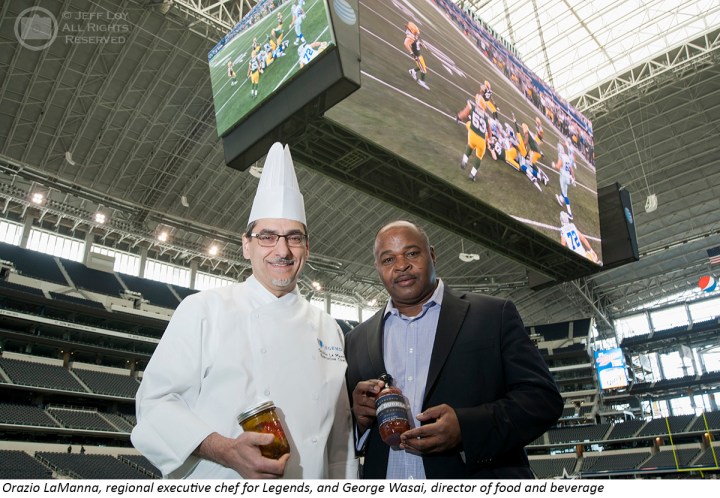
When George Wasai—director of food and beverage for Hospitality division of Legends at AT&T Stadium in Arlington, Texas (home of the NFL’s Dallas Cowboys)—played football in the 1980s for Bishop College (now Paul Quinn College), he never suspected that he would return to that same field more than two decades later as part of a team making a difference in the community.
In 2007, Paul Quinn College President Michael Sorrell eliminated the school’s football program as a cost-cutting measure for the small Dallas school. At the same time, Sorrell was working with real estate developer Trammel Crow to find a solution to the economically depressed area’s problem as a “food desert” (a scarcity of local, fresh food). The vacant football field now became a valuable asset and the school’s organic “WE Over Me Farm” was born.
Across town, the change from football to farming was noticed.
“It all started with the connection with [Wasai] and understanding that they were losing a program,” says Orazio LaManna, regional executive chef for Legends. “We’ve always wanted to get into sustainability and organics, and when we heard that they were losing their football program and turning their field into an organic farm, we just jumped all over it and started the partnership.”
The farm, which is staffed entirely by students through Federal Work Study and Work College programs, has expanded over the years to two acres and now includes more than 50 varieties of vegetables, a small orchard, a chicken coop, beehives and even an aquaponics system to raise tilapia. The farm sells directly to the local community and donates more than 10 percent of its produce to local charitable organizations.
As a way to encourage entrepreneurship, students are involved in all aspects of running the farm. Responsibilities include everything from planting, caring for and harvesting the crops; caring for the livestock; business planning; and running a booth at a local farmers market.
“The biggest challenge has always been and continues to be keeping up with demand, and our ambitions,” says Hannah Koski, farm manager. “We always want to increase our ability to provide food not only to our community, but to our many loyal clients including Legends, as well as to expand our programming to meet community needs. But all of this requires time, additional infrastructure and other resources, which we can’t always secure as quickly as we’d like.”
Along with being a major client, Legends has also taken on an active role in the farm by advising the college on techniques and materials, and even participating in the growing process.
“We see things getting planted, which is very exciting for us,” LaManna says. “You just don’t see that partnership anywhere else.”
Legends’ involvement with the farm also allows them to ensure the quality of the product.
“We don’t accept anything unless it’s high quality,” LaManna says. “That’s why we sit down together and we go through what we want to see. They talk to us about the seeds that they’re bringing in and make sure that they’re high quality. We go out there every year to plant. We make that a huge event and this year we’re going to make it bigger. We’re going to get all the managers involved.”
The Legends staff also monitors the crops throughout the season and helps pick the produce when it’s ready.
“It starts with the planting and then we help them harvest as well,” Wasai says. “We participate in the whole process.”
LaManna says Legends doesn’t harvest everything but does send staff out to the farm for various reasons.
“[We] go out a couple of times and just have fun and give back and send some of our chefs out there to hand pick some things for special events,” he says. “To be able to go in the actual fields, you don’t see that, ever. That’s pretty cool for us.”
Once the produce arrives at AT&T Stadium, it’s put to a variety of uses, from ingredients for the house-made salsa to sauces and the vegetable platters for the suites. The seasonal availability of certain items can also help the staff get creative with the dishes they create.
“We’re always communicating and they’re telling us what’s coming up and we’ll plan that [into the menu] whether it’s kale, broccoli, tomatoes, whatever it is,” LaManna says. “That’s the flexibility we have with our clubs, our restaurants—we change the menu every single game. So we have the flexibility of saying, ‘OK, this week they’ve got spinach and we’re going to incorporate that with salmon,’ for instance, and do a nice wilted spinach and garlic and sit the grilled salmon on top of that.”
LaManna estimates that 10 percent of their produce is purchased from the WE Over Me Farm. Considering the scale of Legends’ AT&T Stadium operation and the size of the farm, though, that can add up to hundreds of pounds of produce a month.
“There are no products that go to waste on their side because we will clean them out,” he says. “Their challenge is to keep up with us.”
Legends is currently the farm’s largest client and even though LaManna would like to make larger purchases, he understands the true mission of the farm and appreciates the amount the school can dedicate to them.
“I want to be their only client,” he says laughing. “They grow it for the community and they give back to that area because it’s a food desert. They dedicate a lot of that farm to us.”
While a majority of the produce purchased goes into game-day concessions, a small portion of it makes it into the catering menus of the more than 400 non-sport events that the stadium hosts every year, with crowds ranging from 50 to 10,000 attendees.
In addition to the investment in local produce, AT&T Stadium works with local nonprofit groups to staff more than 75 percent of the concessions for games in return for a portion of the profits. They also utilize local companies to bottle the ketchup, barbeque and hot sauces that the organization sells commercially, as well as acquiring a portion of their meat from Dallas-based Winn Meat Company, who source the beef locally.
The organization also participates in Paul Quinn College’s “A Community Cooks” program, which brings local chefs to the school for a dining event held at the farm as a fundraiser for the school.
For Chef LaManna, there’s satisfaction in not only using fresh, high-quality products, but knowing that the source of the product has a wider effect.
“The product is good; it’s as good as you’re going to get,” he says. “They pick and they deliver it. They don’t pick and hold it somewhere. It comes as fresh as it can be and… it’s all organic. It certainly makes a difference to us. We take a lot of pride in using fresh products like that.
“For us it’s probably more of a special feeling, because we know where it’s coming from. As chefs we know what we’re cooking with. We know how it started, we know how it’s being handled and we know how it’s being treated. And we know we’re giving back to the community.”
Legends hopes their partnership with the WE Over Me Farm will serve as an example of what can be accomplished when an open space is given a second chance.
“A wasted field is not necessarily a wasted field,” Wasai says. “You can use it for something. I look at [the farm] and say, ‘25-30 years ago, I was playing football on this field.’ You see a lot of buildings with land around them and you can put it to good use—that’s what Paul Quinn College is doing and we hope that other communities see that you can make good use of the land.”
LaManna adds: “Hopefully we can inspire other venues to kind of do the same and partner up with a school or a community.”
This blog post originally appeared in the April 2014 edition of The Meeting Professional. It has been republished here with permission.
Discover more from Words, Photos, Music & Travel
Subscribe to get the latest posts sent to your email.
 Words, Photos, Music & Travel